Finding my research path: Taking a big swing

Image by Free-Photos from Pixabay

About a year ago, my article “Research is an Activity and a Subject of Study” was published in College & Research Libraries. This article represented something of a turning point for my research and writing, first because it drew inspiration from outside the library and information science field and second because it was a much bigger swing than what I’d previously written. But the big ideas in this article have led me down a path of discovery that has made me more excited about research and writing than I was before. And it’s led to some great conversations. So I’m really glad I took that big swing.

I wanted to take some space now to reflect on what taking that swing was like in part as a way to encourage others to do the same with their own ideas.

Read More »

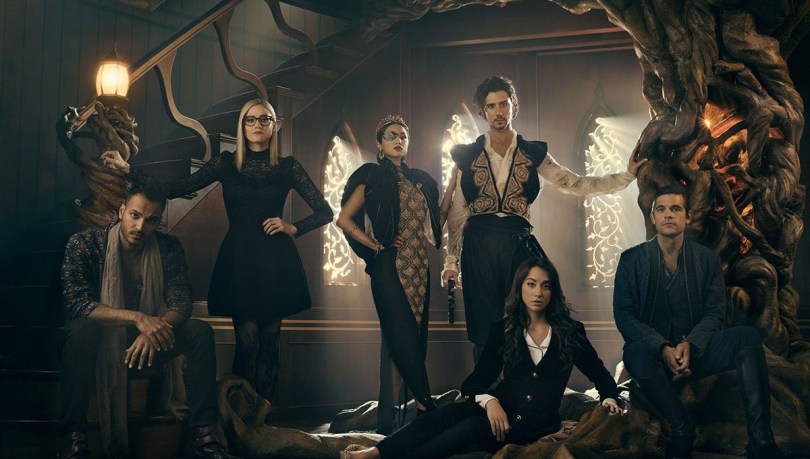
Magicians and libraries that aren’t libraries

Image credit: https://www.syfy.com/syfywire/book-vs-tv-the-magicians

(Warning: This post contains spoilers for the television show The Magicians through the end of its fourth season)

I spent some time recently watching the first few seasons of The Magicians. Yes, I’m still getting over that ending. But I also felt the need to comment on the Library and libraries on pop culture in general.

In the show,(1) the Library is its own world (hence the capitalization). Sort of like the library in the two-part episode of Doctor Who “Silence in the Library/Forest of the Dead,” but without the carnivorous shadow monsters. Probably. The Library is overseen by Zelda, the Head Librarian, who is played by Mageina Tovah.(2) She is very protective of the books in her collection. So much so that when two of the characters break the Library’s rules about touching the books, they are banished from the Library forever. Which seems fair since the books in the Library contain all of the knowledge in the universe and are also one of a kind.

So the Library is not, in fact, a library. It’s an archive.

Read More »
The Contextual Nature of “Un-Research”

Image by David Mark from Pixabay

At this point, I’ve written a few things about the contextual nature of research and offered some thoughts on how to bring that idea into information literacy classrooms. I’ve also mentioned that my opportunities for changing my own teaching in the way I’m advocating for are somewhat limited at the moment.

Then I realized that some of these ideas actually have connections to something I tried in the past and wrote about in an article that was published in Communications in Information Literacy called “Teaching Information Literacy Through ‘Un-Research.’”

Read More »

Using the annotated bibliography as the “establishing shot”

Image by PublicDomainPictures from Pixabay

Lately I’ve been reading some scholarly literature from the writing studies field for a project I’m working on. I’m always fascinated by the parallels I see between how writing studies practitioners/scholars and information literacy practitioners/scholars talk about what they do and the challenges they face. I really think we need a space for practitioners and scholars in these two fields to talk to each other about their work.

Anyway, I found what I think could be an interesting new parallel in the article Documenting and Discovering Learning: Reimagining the Work of the Literacy Narrative by Julie Lindquist and Bump Halbritter.

This article has me thinking: what if the research we ask students to do in information literacy classes came at the beginning of the course instead of at the end? What if we used it as an “establishing shot”?

Let me explain.

Read More »

Thoughts on the Leadership Institute for Academic Library Managers at Siena College

Image by Gerd Altmann from Pixabay

A few weeks ago, I had the opportunity to attend the Leadership Institute for Academic Library Managers at Siena College, featuring sessions on emotional intelligence, strategic thinking, communicating effectively, leading change, leadership style, and developing teams taught by Paul Thurston, David Liebschutz, Melinda Costello, and Erik Eddy. I found this to be an incredibly valuable experience where I learned far more than I have space for here. But I wanted to at least reflect on a few key points, things that I learned not only about leadership but also about myself.

Read More »

ACRL Questions: Talking to faculty about the contextual nature of research

Image by TeroVesalainen from Pixabay

This is a new post in an ongoing series where I’m answering questions that came up during my ACRL presentation “Research is Not a Basic Skill.” Previous posts discussed student proficiency versus student confidence, models for teaching the contextual nature of research, why we’re talking in terms of “research” instead of “information literacy,” and the relationship between some of these ideas and critical information literacy.

Today I’m going to spend some time on talking to faculty about the contextual nature of research.

Read More »

Defining research

Image by Hebi B. from Pixabay

I’ve been talking quite a bit here so far about research and I realize that I haven’t really defined my terms. On the one hand, “research” is a term that doesn’t seem to need defining. You know it when you see it. For example, when you type “research” into Pixabay, the images that come up show things that are recognizably related to the idea of research. There’s a guy staring at a bunch of notes pinned to a board. A microscope. A book with some glasses resting on it. A woman sitting at a computer while sipping from a cup of coffee. Stacks of books in a library. Another woman in a white coat in a lab. Beakers. Charts. Graphs.

Research. Obviously.

But maybe it’s not so obvious.

Read More »

I created a Skillshare course and I feel weird about it

Image by Michal Jarmoluk from Pixabay

So in May, I completed the Skillshare Teach Challenge, which is where you spend a month creating a course for the Skillshare platform. I first discovered Skillshare after searching for a viable side gig to replace one I’ve been doing for a long time that I knew needed to come to an end. The materials on Skillshare make a big deal about how their top teachers make hundreds of thousands of dollars a year through their platform, which I took with a large grain of salt and actually if you dig deeper, you find out that productive teachers on Skillshare who release about one course a month make around $300 a month, which still seemed overly optimistic for my case. Anyway, I had an idea for a possible course and I wanted to try it out.

The course I created for the challenge is called Working with Scholarly Articles. Here’s the referral link, if you’re interested: https://skl.sh/2YTGicb

And here’s how creating it went.

Read More »