Thoughts on Box Office Poison

Image by Igor Ovsyannykov from Pixabay

In trying to understand the role of research in creative writing, I’ve taken something of a detour into research on creative writing pedagogy and the history of English as an academic subject. This information is helping me understand the larger context of how creative writing is taught and why conversations about the role of research may not be part of those teachings.

Anyway, one of the first books I found on the subject was Can It Really Be Taught?: Resisting Lore in Creative Writing Pedagogy, a collection of critical essays edited by Kelly Ritter and Stephanie Vanderslice that was published in 2007. A lot of the essays, particularly ones that come early in the book, are fascinating explorations of why creative writing is taught the way it is and why, in the authors’ opinions, that needs to change. It reminded me a lot of conversations I’ve seen in the library and information science field about how information literacy is taught.

Toward the back of the book is an essay by Wendy Bishop (to whom the book is also dedicated) and Stephen Armstrong called “Box Office Poison: The Influence of Writers in Film on Writers (in Graduate Programs)” which, as the title suggests, is an analysis of how the act of writing is portrayed in cinema.

Or, more accurately, how it is not portrayed.

Read More »
Magicians and libraries that aren’t libraries

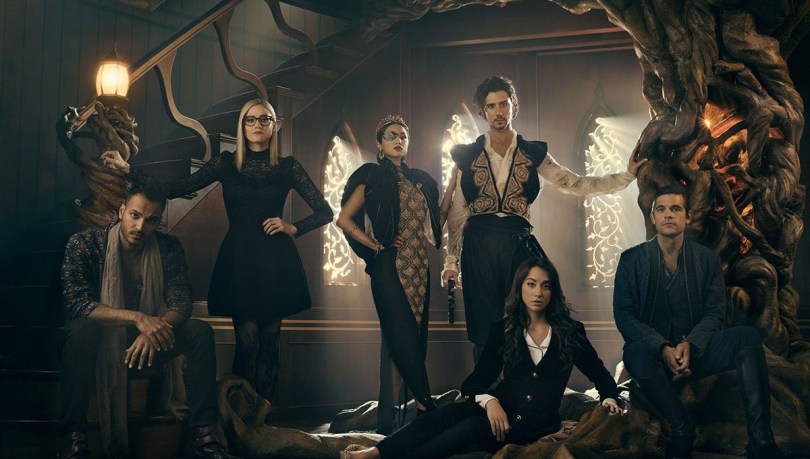
Image credit: https://www.syfy.com/syfywire/book-vs-tv-the-magicians

(Warning: This post contains spoilers for the television show The Magicians through the end of its fourth season)

I spent some time recently watching the first few seasons of The Magicians. Yes, I’m still getting over that ending. But I also felt the need to comment on the Library and libraries on pop culture in general.

In the show,(1) the Library is its own world (hence the capitalization). Sort of like the library in the two-part episode of Doctor Who “Silence in the Library/Forest of the Dead,” but without the carnivorous shadow monsters. Probably. The Library is overseen by Zelda, the Head Librarian, who is played by Mageina Tovah.(2) She is very protective of the books in her collection. So much so that when two of the characters break the Library’s rules about touching the books, they are banished from the Library forever. Which seems fair since the books in the Library contain all of the knowledge in the universe and are also one of a kind.

So the Library is not, in fact, a library. It’s an archive.

Read More »

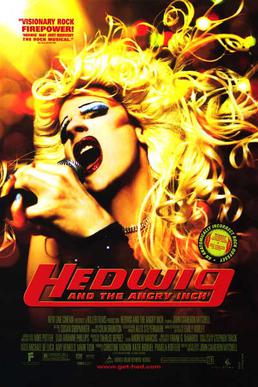
Hedwig and the Angry Inch is secretly about the ethical use of information

Image source: Wikipedia

One of my favorite pieces of scholarly literature in the library and information science field is an article by Emily Dill and Karen L. Janke called “New Shit Has Come to Light: Information Seeking Behavior in The Big Lebowski.” It is exactly what it sounds like: a study of the information-seeking strategies of the characters in The Big Lebowski.

I think of this article every time I watch Hedwig and the Angry Inch because every time I watch Hedwig, all I can think about is how, underneath all of its other themes, it is, at its core, a lesson about the ethical use of information.

Let me explain.

(The following includes spoilers for Hedwig and the Angry Inch, both the movie and the play.)

Read More »